
Water Supply News

Note: This page began life as an article in the July 2026 issue of the Blueridge Bulletin. It will be updated as events warrant.
October 15, 2026 Update
Two items of note today:
- Recent reporting (this story) suggests that Metro Vancouver got very close to suffering water pressure issues on June 23, 2026, when water use was very high and Stage 3 restrictions were in place, but Surry was not following those rules. Whether there will be any fallout from this incident remains to be seen.
- Stage 1 water restrictions are lifted. Metro Vancouver’s water dashboard shows current reservoir levels well within the 10-year typical range.
September 1, 2026 Update
Water restrictions have been relaxed again, down to Stage 1, our usual levels. This happened because reservoir levels are normal for the time of year, despite the very poor snowpack we started the season with.
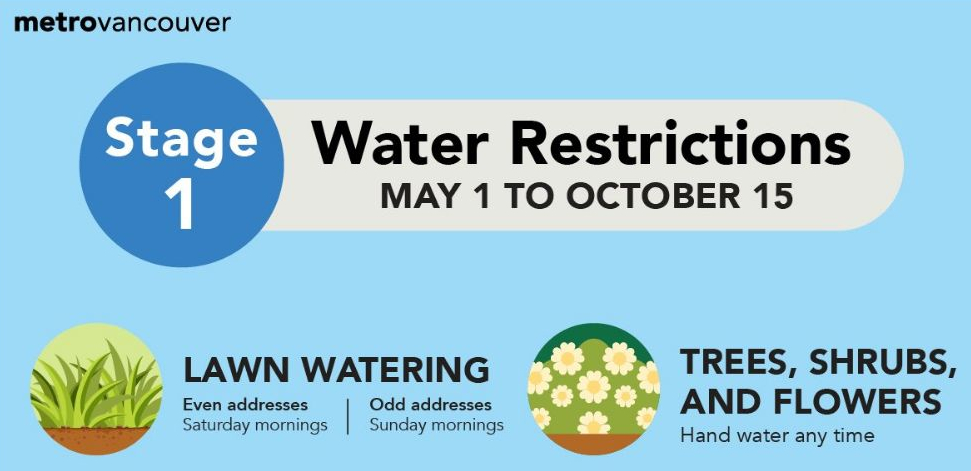
If the weather remains cool with occasional rain, and our usage remains normal, we could be under no restrictions again on October 15th, as normally happens.
July 16, 2026 Update
Thanks to the completion of some work on the Stanley Park Water Supply Tunnel, the pipe bringing water to Metro Vancouver under the First Narrows has been reopened. This reduces water supply and pressure concerns, so water restrictions have been rolled back to Stage 2.
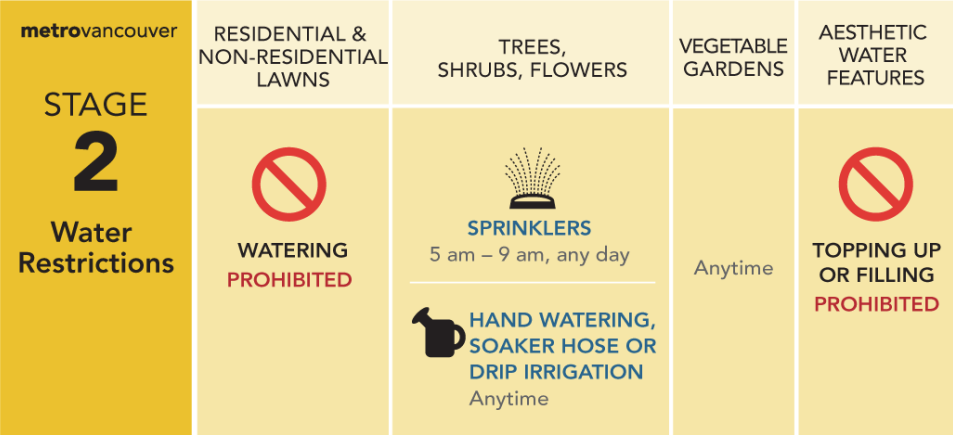
But water remains a scarce commodity this year. The snowpack was very small and disappeared early. We have to get through until the rains return on the water we currently have available, so conservation is key.
July 14, 2026 Update
Metro Vancouver has announced a return to Stage 2 water restrictions beginning on Thursday, July 16th. Their press release says this is because a key milestone in the Stanley Park Water Supply Tunnel Project has been met, so they can bring the water line under the first narrows back online.
However, there is no snowpack, so the only thing keeping us from returning to Stage 3 restrictions later this summer is conservation
As of this writing, reservoir levels remain in the normal range but are slightly below what they were in both 2025 and 2024.
July 1, 2026 Status
At the end of the June 22, 2026, DNV Council meeting, during the reports section, Councillor Muri and Mayor Little spoke about the current water situation. Both are in a position to provide useful and accurate information. Councillor Muri is the DNV’s representative on the Greater Vancouver Water District (GVWD) Board of Directors, and Mayor Little is a member of the Metro Vancouver Water Committee.
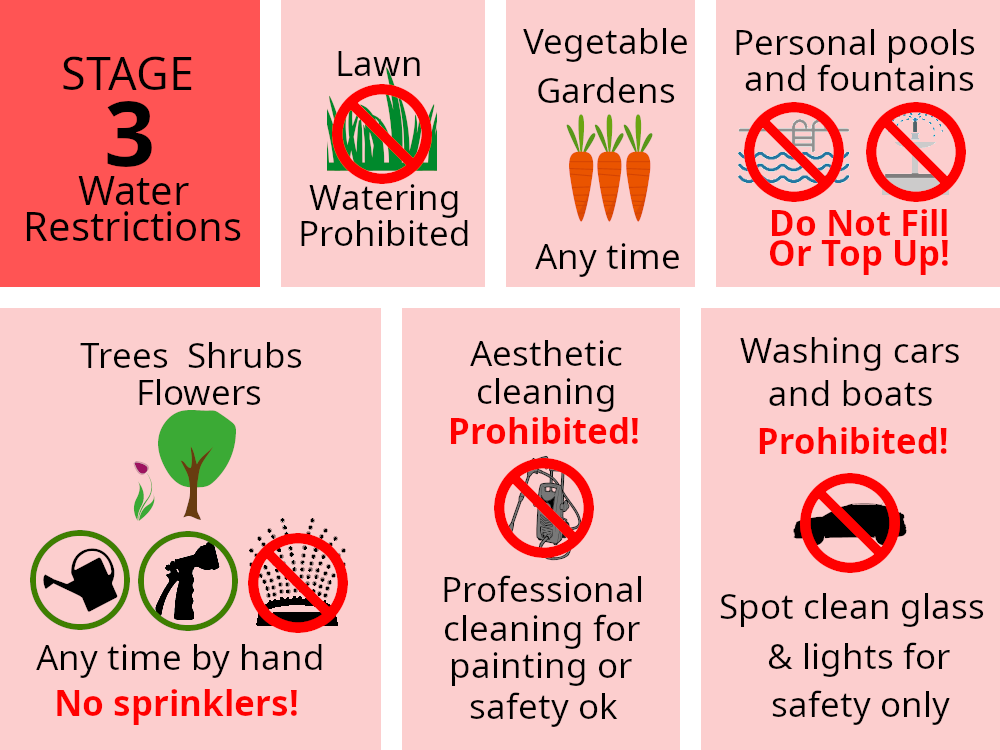
At the moment (June 23, 2026), Stage 3 water restrictions are in place. The graphic above shows the basic rules, and this chart from Metro Vancouver provides more details.
Stage 3 restrictions are very significant. The only thing more stringent is Stage 4, which essentially eliminates all non-essential water use for both individuals and businesses. Stage 4 is an emergency situation, as bad as it can get. There is no Stage 5.
Why We’re at Stage 3 Now
Stage 3 rules were imposed for two reasons:
- There’s no snow. According to Mayor Little, at the time Stage 3 was imposed, June 8, 2026, the snowpack was at 9% of normal levels. Metro Vancouver’s Water Dashboard confirms that, showing that the snowpack was basically gone by the time June arrived, but typically there is some snow present through the end of July. Snowmelt usually replaces the water we consume from our reservoirs in the summer, but that can’t happen this year. We’re left with only rain and water conservation as our ways of stretching the available water through the fall.
- Work installing a new water supply line is at a critical point. This project is called the Stanley Park Water Supply Tunnel, and it has been under construction since late 2024. It involves replacing an old tunnel under Stanley Park with a new one. Currently, bypass pipes are being installed at both ends of the old tunnel, so they have the space to build the new one. The connection of those bypass pipes requires the tunnel carrying water from the Capilano Reservoir to be shut down. That puts more strain on the other tunnels bringing water out of the reservoirs, and if water levels drop too low, there could be impacts on water pressure, making firefighting difficult. Stage 3 rules help reduce the likelihood of such an event.
About Surrey
As of June 23rd, the City of Surrey has not put Stage 3 water restrictions in place, opting to stay at Stage 2. According to news reports, they have claimed their water use is going down under Stage 2, and as a result, their situation is not as severe. That may be true, but it’s irrelevant. Metro Vancouver’s water supply is a web of pipes carrying water in various directions. Surrey’s water comes through the same pipes that everyone else’s does, and they are just as dependent on Metro Vancouver for water – and water pressure – as any other city. In addition, their actions directly affect every other city, as well as set a precedent. Councillor Muri discussed this issue and said the vast majority of the GVWD board voted to send Surrey a letter, asking them to impose Stage 3 restrictions. In addition, Mayor Little pointed out that history will not be kind to any politicians who don’t get on board with these requirements. This is about our region standing together in the face of a potential water crisis.
What Happens Next
According to Councillor Muri, the new bypass pipes are being filled with water and will go into service once they are fully tested and sanitized. Metro Vancouver says that should be done in mid to late July. At that time, depending on the region’s water use and reservoir levels, Stage 3 rules may be removed, and we could return to Stage 2. However, fall is still a long way off, and there is a risk of the region dropping back to Stage 3 – or even Stage 4 – if our water use is not controlled.
Longer term, the issues are significant. Residents of Metro Vancouver have historically used more water per person than anywhere else in Canada, but that is no longer sustainable. It is true that our water consumption per person has dropped over time, but thanks to population growth the average use per day for the entire system has been basically stable since about 1997. (See chart on page 42.) Climate change, particularly the reduced snowpack that results from consistently warmer temperatures, adds stress to the system, and makes Stage 4 restrictions more likely every year. New water supplies – additional reservoirs and deeper intakes in existing reservoirs – are very expensive and take a long time to develop. We’ll all pay that price if we don’t find ways to reduce our collective water consumption.