
Blueridge and Small-Scale Multi-Unit Housing

Note: this article was originally published in the March 2026 issue of the Blueridge Bulletin.
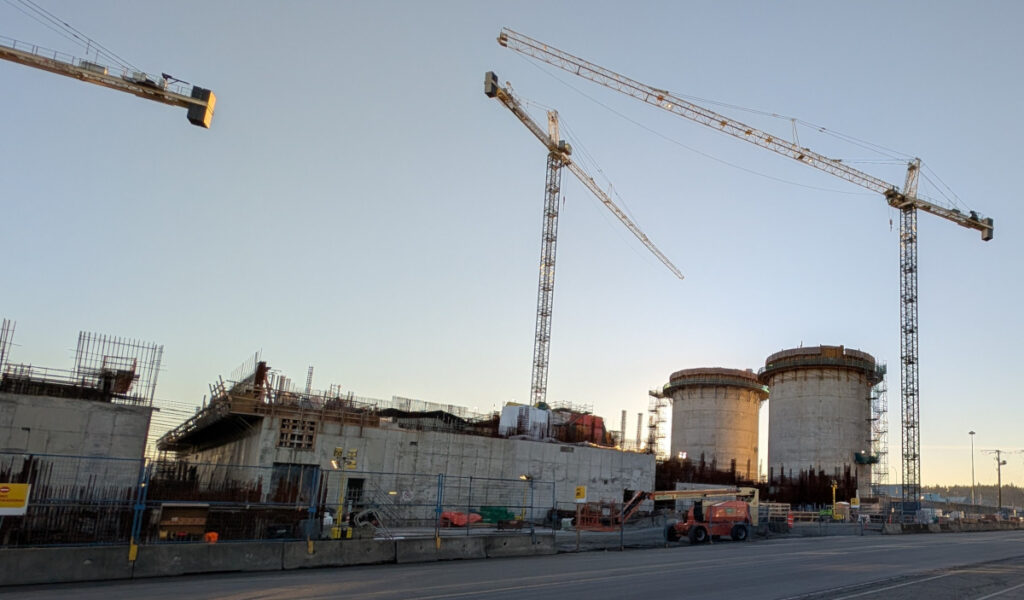
North Shore Wastewater Treatment Plant Update [as of March 2026]
Jeff Powell
Few topics inspire as much heated discussion as the North Shore Wastewater Treatment Plant (NSWWTP) and the costs associated with it. This article provides a brief summary of the history of the plant and a discussion of the costs residents of the District of North Vancouver face at this point. It attempts to stay as factual as possible.
For the timeline, I have relied on this web page from Metro Vancouver, which provides extensive documentation with links to meeting minutes and committee reports. It’s part of a larger set of documentation about the NSWWTP. In addition, I contacted Metro Vancouver and spoke with Chris Mealing, the Director of the North Shore Wastewater Treatment Plant Program since September 2025, and Kris Etches, who is the Community Engagement Manager in Liquid Waste Services. Both were very helpful, and Chris Mealing mentioned he is a North Shore resident and has the same concerns about these costs that we all have.
Condensed NSWWTP timeline:
- 2005: Planning for the new NSWWTP began.
- 2008: The selected site was purchased.
- No cost for the land is shown on the website, but I was told the cost was about $15 million at the time. That amount is not included in the full $3.86B budget.
- 2011 & 2012: Planning for the development of the new plant began in earnest.
- Nov 2013: The first cost estimate for the NSWWTP was about $700 million (in 2018 dollars), with construction to begin in 2014 and completion by 2020.
- Apr 2017: After additional design work, Metro Vancouver contracted Acciona to develop the NSWWTP. The estimated cost was $780 million, with completion by December 2020. Kris Etches points out that the contract signed here made Acciona responsible for the design, construction, commissioning, and process performance of the plant at a fixed cost.
- Aug 2018: Construction begins.
- Spring/Summer 2019: Acciona says they cannot complete the project on budget and on schedule. “Increased costs” are expected, and the completion date moves out 2.5 years.
- Feb 2021: The revised cost estimate is now $1.058 billion with completion in 2024.
- Jun 2021: Metro Vancouver receives a claim from Acciona saying the project will take another 26 months and cost “an additional cost of almost double the original contract price.” (That would make the new estimate approximately $2.5 billion.) In response, Metro Vancouver says Acciona had “no basis for this claim.”
- Sep 2021: Acciona lays off approximately 130 staff working on the project.
- Oct 2021: Metro Vancouver starts the process of terminating the contract with Acciona.
- Early 2022: PCL was selected as the new contractor to help the transition and inform a new estimate for the completion of the project.
- Mar 2022: Acciona begins legal proceedings against Metro Vancouver. Their legal claim (PDF) is available online.
- Jun 2022: Metro Vancouver countersues Acciona. This legal counterclaim (PDF) is also available online, as is their response to Acciona’s legal claim (PDF).
- Nov 2023 – Mar 2024: The NSWWTP task force holds 4 meetings to examine options to complete the plant.
- Mar 2024: The revised cost estimate is now $3.86 billion with completion in 2030.
- May 2024: Cost allocation for the NSWWTP is approved by the Greater Vancouver Sewerage & Drainage District (GVS&DD) Board. This is when the fees passed to various municipalities were set. Those fees get passed on to residents by the municipalities themselves.
- Oct 2024: Metro Vancouver executed the contract with PCL to complete construction of the NSWWTP, with a total contract price of $1.95 billion. (This is just what PCL is being paid. Adding in expenses already paid and other costs to companies other than PCL brings the total to $3.86B.)
- Jun 2024: An independent review of the NSWWTP program was announced.
- Jul 2025: Independent review paused until the dispute with Acciona is resolved.
Key points about the NSWWTP project:
- It is still technically possible that there are additional expenses still coming that have not yet been accounted for and that are not part of the $3.86 billion price tag. However, when pressed, Director Mealing stated that at this time he is confident that the plant can be completed for the existing $3.86B budget.
- You may have heard about a statement from Cheryl Nelms, General Manager for Project Delivery for Metro Vancouver, who said, “Our new designer of record has taken over the design from the previous contractor, and so there may be some parts that are challenging for construction, which are being discovered at the moment.” Director Mealing stated that these are issues like interfacing between old and new concrete pours. It is his stated position that such things are manageable within the existing budget. In addition, Nelm’s statement has been interpreted to mean a new designer took over recently, but that isn’t correct. The “new” designer of record took over the design in 2022.
- One known additional expense that has not been accounted for is the decommissioning of the old Lions Gate WWTP. Some planning for that is included in the estimate, but the actual work is not. The decommissioning design should begin in late 2026 or early 2027, and a full cost for that decommissioning will be produced as part of that effort.
- The costs for the decommissioning will be split per the cost apportionment bylaw governing the GVS&DD. That bylaw is subject to change at the discretion of the Metro Vancouver Board, but currently it states that 30% of the decommissioning costs will be paid by the North Shore, and 70% will be paid by the other sewerage areas in Metro Vancouver.
- Asked about the very large jump in cost between the $1.058B and the current $3.86B plan, and whether Acciona might have grounds for their contention that a large cost increase was required in June 2021, Director Mealing declined to comment due to the ongoing litigation. He stressed that there are good reasons for that lack of communication.
- When asked about either winning or losing the lawsuits and the cost implications involved, no answer was forthcoming for the same reason: the lawsuit situation requires him (and other Metro Vancouver staff) not to comment or speculate about such things.
- There have also been questions about whether operating the revised (and much more expensive) plant will cost the same as was originally forecast. The answer is yes, the operational costs will be about the same. Despite the construction cost increase, the plant hasn’t changed scope in any way significant enough to change the expected operating costs.
- There have been numerous calls from both the public and various politicians for a public inquiry into the NSWWTP by the province, but all have been rebuffed so far.
What will it cost?
On costs paid by Blueridge residents, this research has revealed that there are two very different ways of looking at how the NSWWTP project is being billed to the residents of Metro Vancouver, and those cause a lot of confusion. This is in part due to the fact that the above-mentioned cost apportionment bylaw (PDF) is very complex and has been amended several times, but it’s also due to the fundamentally different perspectives the two views take.
In the press we are all likely to have seen a cost breakdown that looks like this:
- North Shore households will pay an extra $590 per year for 30 years.
- Households in the Vancouver Sewage Area will pay an extra $150 per year for 15 years.
- Households in the Fraser Sewage Area will pay an extra $90 per year for 15 years.
- Households in the Lulu Island Sewage Area will pay an extra $80 per year for 15 years.
- The charges to North Shore households are to be phased in over 5 years starting in 2025. Other areas see the charges phased in over one year.
- These charges are in addition to the ongoing basic charges paid for sewer service.
When presented that way, it looks like North Shore residents are shouldering the bulk of the costs for the plant. However, the truth is more nuanced. As best I can tell:
- For the first $1.058B – the February 2021 estimate – the North Shore pays 46%, and other areas pay 54%.
- For the remaining $2.8 billion portion of the overall cost, the three other sewerage areas are each taking on an additional $10 per household above the usual funding formula.
- This results in 37% of the total bill going to the North Shore and 63% going to the other sewerage areas.
- Households in the other sewerage areas pay less per year than those on the North Shore, and for a shorter period, because the costs are shared across a substantially larger population.
How to convert from one view of these expenses to the other is not at all obvious. Such a calculation requires an understanding of what the cost apportionment bylaw stated at various points in time, details about how such costs are split over the different sewerage areas, and the number of residences in each sewerage area. Without those details, the translation from one to the other is simply not possible. But clearly someone has those details, and such a translation is definitely possible. Our annual utility bills prove that.
Regardless, it seems that despite the higher annual payments and the longer time we will make those payments, the North Shore is not paying for the bulk of the new plant. Whether what we are paying is fair is an entirely different conversation.
In the DNV, payments are even more complicated. Between 2015 and 2024, under the auspices of a reserve fund bylaw, the DNV collected money to help reduce the cost of the NSWWTP for DNV residents when the bill came due. For the years 2025-29, the DNV is using those collected funds as intended, so our utility bills are somewhat smaller than the full amount they would otherwise be. In 2025 each household saw a credit of $69.95, and in 2026 the credit is about $123. In 2030 those reserve funds will be exhausted, and DNV residents will pay the full $590 annually until the billing period ends in 2055.
Politics continues to play out around the NSWWTP. Theoretically, anything – even the costs paid by North Shore residents as they are currently planned – could change. In addition, these costs are a major point of contention and will be a campaign issue for years to come.
If you are interested in learning more about the NSWWTP, a good place to start is this page on the BCA website documenting the plant and linking to many resources relating to it.